What is deep learning, and how does it differ from traditional machine learning?
Deep Learning vs. Traditional Machine Learning: Unraveling the Differences
In the world of technology, machine learning and deep learning are two powerful tools with unique approaches in diverse industries. Moreover, these two are part of artificial intelligence and are utilized for solving problems.
Let's delve into what sets them apart and how they shape the landscape of modern AI.
Deep Learning:
As the name implies, deep learning is the most advanced machine learning concept with a subset ofartificial neural networks. These networks consist of interconnected layers of nodes that process data, letting the model learn and understand complex patterns.
Deep learning techniques:
It excels at tasks like picture and audio recognition, language processing, and even playing games like Go and chess because it can independently extract hierarchical features from raw input through numerous change layers.
Traditional Machine Learning:
On the other hand, traditional machine learning utilizes a range of algorithms that study data and generate decisions or predictions. These algorithms heavily rely on features retrieved from the data by humans. They frequently entail operations like feature selection, model training, and data preprocessing utilizing methods like decision trees, random forests, support vector machines, and others. Traditional machine learning techniques are effective in fields where feature engineering is feasible and for structured data.
Key Differences
1. Feature Extraction:
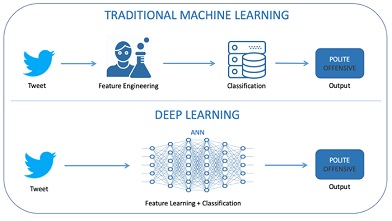
- Deep Learning: The most unique and standout feature is its ability to learn pertinent features from raw data automatically. Due to this, the requirement of manual feature engineering has been reduced, making it particularly valuable when dealing with unstructured data like images, audio, and text.
- Traditional Machine Learning: Feature engineering is a crucial stage in machine learning. To enable practical model training, experts must manually create relevant features from the data. It takes time and requires domain knowledge to complete this process.
2. Architecture:
- Deep Learning: In Neural networks, deep learning allows them to learn intricate representations and abstractions of data. Convolutional Neural Networks (CNNs) for images and Recurrent Neural Networks (RNNs) for sequences are common architectures.
- Traditional Machine Learning: Deeper models are frequently used in conventional algorithms. They rely on mathematical formulations and decision-making procedures to discover patterns and links within the data.
3. Data Requirements:
- Deep Learning: Big datasets are ideal for deep learning models. The complex architectures and multiple parameters mandate substantial data to generalize effectively and evade overfitting.
- Traditional Machine Learning: In traditional models, data can perform well with limited datasets. In this model, they are less likely to encounter overfitting issues.
4. Scalability:
- Deep Learning: Deep learning models may require a lot of processing and specialized hardware, such as GPUs or TPUs, to manage the massive computations necessary for model training.
- Traditional Machine Learning: Traditional models can run on standard hardware and are less computationally intensive.
5. End-to-End Learning:
- Deep Learning: Deep learning models excel at end-to-end learning, where real outcomes are obtained immediately after raw data input. For instance, when a picture is fed into a neural network, the network instantly generates a classification label.
- Traditional Machine Learning: Traditional methods frequently use multi-step pipelines with distinct stages for feature engineering, data pre-processing, and model training.
Choosing the Right Approach
The choice between deep learning and traditional machine learning is based on several factors:
- Data Type: Deep learning is usually utilized for unstructured data like images, audio, and text, while traditional machine learning can excel with structured data.
- Dataset Size: Deep learning may be more suitable if you have a massive dataset because of its ability to manage vast amounts of data.
- Resources: Consider your hardware and budget; deep learning takes significant processing resources.
- Interpretability: If interpretability is crucial (as in medical diagnosis), traditional machine learning's transparent models might be preferable.
Conclusion:
Traditional machine learning and deep learning are two sides of the same AI coin, both with their advantages. By understanding their differences, you can make informed decisions to solve diverse challenges and shape the future of artificial intelligence.
Stay Connected to Indian America
Get the latest community stories, local events, entertainment and lifestyle updates delivered to your inbox.


