What is generative AI, and how does it work
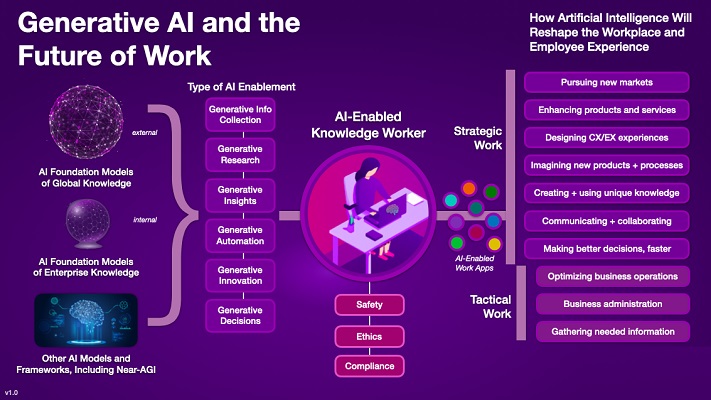
An advanced subset of artificial intelligence called "generative AI" prioritizes creating new, unique content over pattern recognition. To make data that resembles human-created material, like images, text, music, and videos, it uses models like GANs and autoregressive models. These models can create original and worthwhile content by learning from previously collected data, with uses ranging from the arts to developing new drugs. Ethical considerations are required to handle possible issues like deepfakes and fake news.
What is behind the sudden hype about generative AI?
Generative AI has already gained reach among people globally and attained its height and attention in various fields. The fields such as Fashion Design, Video Game Development, Drug Discovery, Architecture and Design, Healthcare and Medical Imaging, Natural Language Processing, Finance and Trading Strategies, Marketing and Advertising, Manufacturing and Engineering, Robotics and Automation, and many others utilize generative AI.
As the demand for generative AI hits the headline, in 2022, ChatGPT launched a chatbot competent in human-seeming interactions. As individuals and businesses find more cutting-edge uses for technology in their daily lives and work, generative AI's influence will increase.
What are the benefits and applications of generative AI?
Generative AI offers a wide range of benefits and applications across various fields. The reason and significant advantage of using generative is:
- Creativity Amplification
- Automation
- Personalization
- Data Augmentation
- Problem-Solving
- Simulation and Testing
- Innovation
- Efficiency and Cost Reduction
Applications:
- Content Creation: It generates text, images, videos, and other media for marketing, advertising, and entertainment.
- Healthcare: Generative AI assists in medical image analysis, drug discovery, and personalized treatment planning.
- Gaming: Generative AI creates game environments, characters, narratives, and dynamic gameplay experiences.
- Natural Language Processing: It powers chatbots, language translation, content generation, and sentiment analysis.
- Finance: Generative AI is used for risk assessment, fraud detection, algorithmic trading, and financial modeling.
- Robotics: Generative AI contributes to robotic motion planning, design optimization, and behavior generation.
- Marketing: It assists in generating personalized marketing content, suggestions, and customer engagement strategies.
- Human-Computer Interaction: Generative AI enables more natural and dynamic interactions between humans and machines.
How does generative AI work?
Generative AI creates new data that closely matches current data using algorithms and models. It entails utilizing a dataset to train a model, then using the trained model to produce new data with properties similar to the training data. Generative Adversarial Networks (GANs), Variational Autoencoders (VAEs), and other methods are utilized in generative AI.
Here's a simplified explanation of how GANs work, which is one of the most popular techniques:
Generative Adversarial Networks (GANs): A generator and a discriminator are the two primary parts of a GAN. These parts are trained in a two-player game-like environment where the discriminator tries to distinguish between actual and created data. At the same time, the generator seeks to provide data that is as accurate as possible.
- Generator: The generator creates data, such as images or text, using random noise as input to produce content that closely resembles the training data. Initially, the created data is frequently of poor quality and bears little resemblance to the genuine data.
- Discriminator: The discriminator accepts accurate and produced data and attempts to classify it as true or false. It is trained using real data from the training set and generated data from the generator. The discriminator improves with time at differentiating between actual and fraudulent data.
What are the uses of generative AI?
Generative AI has a multitude of uses across various domains and industries. Some of the primary benefits include:
Art and Creativity:
- Generating visual artwork, digital paintings, and sculptures.
Content Creation:
- Generate text for articles, blogs, and social media posts.
Healthcare and Medicine:
- Assisting in drug discovery by suggesting potential compounds.
- Personalize treatment plans based on patient data.
Design and Architecture:
- Creating architectural designs, interior layouts, and 3D models.
Gaming and Virtual Worlds:
- Creating virtual environments, landscapes, and terrains for video games.
Natural Language Processing (NLP):
- Translating text between different languages.
Finance and Business:
- Generating financial reports and forecasts.
Marketing and Advertising:
- Crafting engaging content for social media and online platforms.
Education and Training:
- Creating interactive learning materials and exercises.
Robotics and Automation:
- Designing behavior patterns and responses for robots.
Music and Sound:
- Synthesizing sounds and effects for games, movies, and virtual reality experiences.
These applications show generative AI's adaptability and potential influence in transforming numerous industries, boosting creativity, automating tasks, and providing essential insights. New and inventive use cases are expected to develop as technology advances.
What are some examples of generative AI tools?
- OpenAI's DALL-E: Generates images from text descriptions.
- OpenAI's GPT series: Generates human-like text based on prompts.
- AIVA: Generates original music compositions.
- ChatGPT: Engages in conversational interactions using natural language.
- GANPaint Studio: Edits images using GAN-based algorithms
- VQ-VAE-2: Generates high-quality images from textual descriptions.
Moreover, based on the field, the generative AI will differ.
The future of generative AI:
The future of generative AI promises to usher in a new era of creativity and invention. With hyper-personalization as its foundation, generative AI will enable personalized experiences in entertainment, marketing, and beyond. As generative AI transforms industries and interactions, its revolutionary force promises to shift our perceptions of technology, human inventiveness, and the creative process.
We hope this information has given you a profound understanding of the generative AI advantage and its benefits in various fields. So, pursuing a career in such a demanding field will increase your career prospect and streamline your growth in booming technology.
Stay Connected to Indian America
Get the latest community stories, local events, entertainment and lifestyle updates delivered to your inbox.


