.NET Framework in a Nutshell
.NET is a programming framework developed by Microsoft which allows developers to develop software applications more easily and efficiently. Starting from 1990, Microsoft has developed numerous versions of .NET framework. Framework is simply a bunch of code which can be called by the programmer without having it to be written explicitly. Using .NET applications can access database, web services and communication tools in an orderly manner. This software framework runs primarily on Microsoft Windows platform.
.NET framework includes a large class library called as FCL or Framework Class Library which provides language interoperability across various programming languages. FCL also provides data access, user interface, network connectivity, web application development, cryptography, numeric algorithms and network communications. Programs which are written for .NET framework execute in CLR or Common Language Runtime. CLR is an application virtual machine or a software environment which provides security services, exception handling, and memory management.
CLR and FCL together form a .NET framework. Developers create applications by writing their piece of source code using .NET framework and its libraries. Microsoft .NET framework is being used by most of the software applications on Windows platform. Integrated Development Environment (IDE) for the .NET software is also produced by Microsoft which is called as Microsoft Visual Studio.
Architecture
- Common Language Infrastructure: CTL provides a neutral platform for developing any application and to execute the code. It includes core functions such as exception handling, garbage collection, security and interoperability. The functionalities are available across many languages and supported by the .NET framework. Common Language Runtime (CLR) serves as the execution engine for .NET framework.
- Class Library: The framework constitutes a set of standard class libraries which are organized in hierarchy of namespaces. All these class libraries provides many common functions like file reading, file writing, graphic rendering, database interaction, XML document manipulation and so on. These class libraries are available for all CLI compliant languages. These class libraries are classified into: Base Class Library (BCL) and Framework Class Library (FCL).
- Assemblies: CLI assemblies can store the complied CLI code.
- .NET core: For .NET framework, .NET core is a freeware, open-source, cross platform implementation. It’s a virtual machine which manages the execution of .NET programs.
- C++/CLI: C++ and CLI languages were introduced into Visual Studio by Microsoft which complies with Visual C++ programs to run within .NET framework.
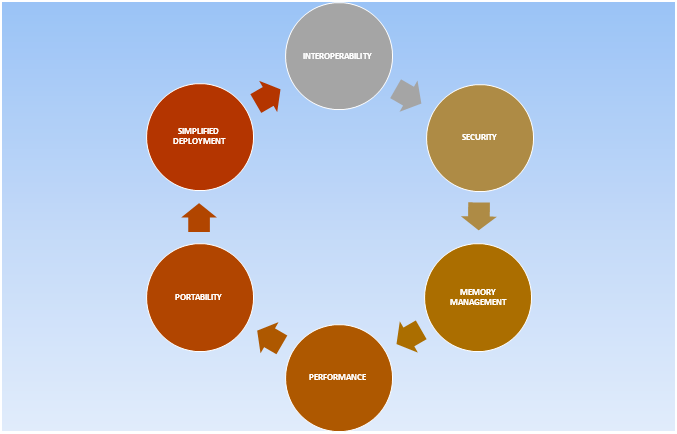
Design Principles
- Interoperability: Generally, computer systems interact between new applications as well as older applications. So, it requires few means to perform the action. .NET framework provides such means to access the functionality present in new and older applications.
- Security: .NET framework is equipped with its own security frameworks with two features- Code Access Security(CAS) and Validation/Verification.
- Memory Management: The tiresome job of allocating and freeing up the memory by the developer is reduced with CLR. The job of handling memory management is effectively performed by CLR as it detects the conditions where the memory can be freed safely. It works on a simple principle- It decides if an object is in use or not by accessing the reference to an object. If an object has a direct or indirect reference then it is considered to be in use. If there is no reference to an object, then such objects are considered to be garbage and the memory allocated for such objects will be freed by CLR.
- Performance:.NET framework used just-in-timecomplier, due to which the application launches faster.
- Portability: Microsoft has implemented the full-framework on Microsoft Windows. It has cross-implementations for other operating systems which makes .NET framework to be super compatible.
- Simplified deployment: By conforming to security requirements, the installation of .NET framework tools will not interfere with any of the existing software installed on the system.
.NET framework also provides a variety of versions for its use in different devices, be it for mobile devices or for embedded devices. Additionally .NET Compact Framework is available on Windows CE platforms and Windows mobile devices. .NET Micro Framework is available for resource-constrained devices.
Stay Connected to Indian America
Get the latest community stories, local events, entertainment and lifestyle updates delivered to your inbox.


