Explained: Project Management Professional Certification and its career possibilities
Who can opt for PMP certification?
Project Management certification is for those professionals and students who want to specialize in project management. The certification course will expose one to the methodologies and processes applied in real time project management.
The certification is most apt for:
- Assistant/Associate Project Managers
- Team leads/Managers
- Software developers in leadership positions
- Project Engineers
- Management Professionals, etc.
Minimum qualifications for enrolling in a PMP certification course
The Project Management Institute (PMI) has laid down certain minimum qualifications that every PMP certification aspirant must possess. This includes both academic credentials as well as practical experience in project management.
PMP aspirants must possess at least an undergraduate degree in project management or management related disciplines. Plus, they must also acquire practical experience in project management or equivalent function in order to be eligible for enrolment.
How to gear up for the PMP certification?
Like any other professional qualification exam, Project Manager certification also requires a great deal of mental and physical effort from the part of the aspirant. Thankfully, the battle is not to be fought single-handedly. There are training programs, online classes and boot camp courses where a student can gain in-depth learning of core subject areas tested in the exam.
Classroom training: These instructor-led classroom sessions give the students a live experience of preparing for the exam with peers bearing the same objective. Direct interaction with the tutors gives an opportunity for the student to clear doubts as and when they arise.
Online training: Online PMP courses gives aspirant much needed flexibility in preparing for the exam. Online training is an option for project managers who want to balance their working hours and training simultaneously.
Boot camps: Boot camps are rapid revision sessions where the entire syllabus tested in the exam is brushed through by an expert tutor, usually a project manager. Boot camps span anywhere from few days to a week. They are ideally taken a month or so before the exam date approach nearer.
Outline of the duties and responsibilities of a project manager
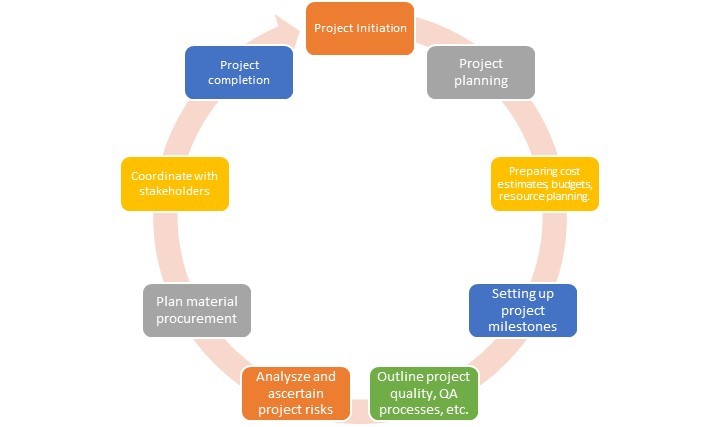
- Project initiation: The project manager will discuss with stakeholder to identify the project objective, requirements and deliverables.
- Project planning: The project manager will estimate the resources required, determine the additional quantum of resources that will be required as the project progresses, when and how to allocate the resources, etc.
Preparing cost estimates, budgets, etc. Cost estimates and budgets are required to ensure that the financial outlay for the project is properly charted out, monitored and controlled at all stages of execution.
Setting up project milestones: project milestones ensure that the project is progressing at a speed that is healthy to meet the deadline. The milestones will include submission and passing of wireframes, securing stakeholder approval, etc.
Quality assurance: Quality assurance is of paramount importance to a project manager. He/she has to outline the QA process based on which test cases, scenarios, etc. will be created and executed in order to achieve the benchmark deliverables.
Analysing project risks: The project manager has to analyse the scenario in which the project is progressing and take necessary countermeasures in case an exigency is to develop.
Plan material procurement: Material procurement comes into play in projects involving creation of tangible assets like infrastructure A project manager has to integrate the cost estimates to the material procurement plan in order to achieve project goals.
Coordinate with project stakeholders: Stakeholders are people who have an interest in the project. The project manager has to coordinate with the stakeholders to ensure that the project is progressing at par with their expectations and to their satisfaction.
Project completion: The wrapping up of the project is usually signified by transfer of assets created, handing over of documents, source code, etc. The project manager has to oversee the project completion process to ensure that the stakeholder(s) receive the deliverables in the agreed manner.
Conclusion
PMP is a Launchpad for management professionals who want to take their career to its zenith. It is not easy but it’s worth the effort.
Stay Connected to Indian America
Get the latest community stories, local events, entertainment and lifestyle updates delivered to your inbox.


