Let The Dhol Rock Your Event
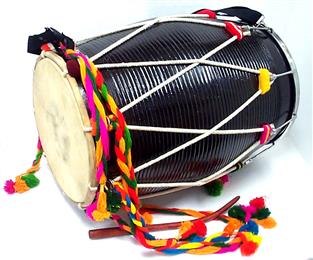
Have you ever come across a North Indian wedding without the sound of Dhol? We guess the answer is a certain “No”! Dhol forms an integral part of north Indian music, especially weddings and festivities.
Here we present to you some important details of Dhol, a very old musical instrument of Indian origin. For beginner Dhol lessons, you can clear your basics through introduction to a couple of beats.However, if you wish to master the art of playing dhol, you can join dhol lessons.
Introduction:
Dhol is a popular folk drum of Northern India, Pakistan and Bangladesh. Dhol is a barrel-shaped or cylindrical drum with skins on both sides. On one side, it has a high pitch and on other side it has a lower pitch. It is very popular in folk music and is essentially nothing more than a larger version of Dholak.
The term Dhol originates from the Northern Indian region of Punjab. This musical instrument has history dated back to the 15th century. It has slowly evolved from a simple wooden barrel or cylindrical drum with skin on either side. The word “Dhol” is said to be of Persian Origin.
As you move around North India, Bangladesh and Pakistan, you can find considerable variation in the technique of playing the Dhol. A few people use hands, sticks and sometimes a combination of both. The well-known style is the Bhangra style which uses sticks on both the sides.
Construction of Dhol:
In Dhol lessons, you can learn the construction of Dhol which is a very interesting affair. The most important part of a Dhol is it’s Shell. There is a regional variation in Dhol - both in size, dimensions and woods used. The most commonly used woods are Mango and Shisham.
Quality of wood is a very important consideration for a drum. Mango wood is commonly used for the drum shell. This wood is extremely light. The majority of weight of the instrument is made up of this shell. Shisham Wood is commonly used to make Dhols. It is superior in sound quality and is very resistant to insects.
Several varieties of skins and membranes are used to skin the drum. The most commonly used skin is goatskin. The thicker skin is used on one side and this thicker skin is loaded with a small amount of a pitch like application known as “DholakMasala”. The combination of thicker skin and acoustic loading of application gives a deeper sound. On the other side thinner skin is used which sounds low.
You can find the presence of Dhol throughout Northern India and even in some parts of Middle East and Pakistan. Dhol is significantly used in different communities belonging to various parts of India as listed below –
- Gujarat and Punjab: Dhol has a significant presence in the North Western State of Gujarat. The Dhol is directly identifiable with Punjabi culture and its association with Gujarat is more indirect. The Dhol is an important accompaniment to the dance forms of Raas and Garba which are linked to the Gujarati sense of self identity.
- South India: Dhol has a limited presence in South India. The social and musical role that it plays in North India is fulfilled by other instruments in the South. The most notable instrument in South India isTavil. In North, where one would find a Dhol in weddings, processions and other festival events, a Tavil would fill that role in the South.
For more idea about dhol lessons, you can contact dhol experts listed here.
Stay Connected to Indian America
Get the latest community stories, local events, entertainment and lifestyle updates delivered to your inbox.


