How will the Deep Learning Landscape Change in the Next Five Years?
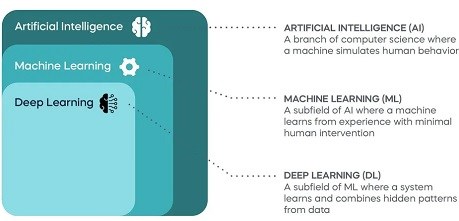
Deep learning is an emerging technology in AI for its standout features and applications. However, there are different opinions on deep learning capabilities based on the industries. Based on the various research on Geoffrey Hinton, all complex problems can be solved with deep learning. According to some scientists, deep learning is where no better remedies exist.
Moreover, from the perspective of the developers and research community, the utilization of deep learning has increased than before. Experts or professional stated that utilizing technologies like deep reinforcement learning, capsule networks, and other approaches aid in complementing deep learning's limitations.
What is the level of interest in deep learning?
- Opinion of the General public
- Deep learning is a technology that improves predictions' accuracy, which helps make data-driven decisions.
- Deep learning analyzes unstructured and raw data to make a better decision.
- These features provide a financial advantage for the organization. From George Hinton's team's various research and analyses, deep learning provides accuracy in Artificial intelligence tasks like image recognition.
- After this, many small to top companies began investing in deep learning, which has become stable today.
Research community
The research community sees deep learning as a bridge between disciplines, driving architecture innovation like transformers and attention mechanisms. Transfer learning boosts performance while transparency, fairness, and ethical considerations gain focus. Adversarial robustness, hardware optimization, and neuro-inspired models advance alongside creative generative applications.
Developer community:
From the point of view of the developer community, Keras and TensorFlow are popular open-source libraries for deep learning. Some of the most popular libraries, like PyTorch, Sckit-learn, BVL/Caffe, MXNet, and Microsoft Cognitive Toolkit (CNTK) help developers quickly build deep learning models.
These libraries and other open-source libraries utilized for deep learning are written in JavaScript, Python, C++, and Scala.
What are the technologies that can shape deep learning?
Deep learning has an exponential growth in the field of Artificial Intelligence. Due to the challenge of facing big data, AI experts like Geoffrey Hinton and other scientists and, prominently, Gary Marcus work on deep learning and suggest unique methods to enhance deep learning solutions.
These methods include:
- Introducing reasoning or prior knowledge to deep learning
- Self-supervised learning
- Capsule networks, etc.
Capsule networks
Geoffrey Hinton introduced this new deep neural network architecture. Capsule networks work better with vectors and can make estimations on the inputs.
They compile the results they discover into a vector. As a result, the vector moves when the image's orientation changes. According to Geoffrey Hinton, CNN's method for object identification differs significantly from human perception. CNNs need to be modified for problems like rotation and scaling, with the aid of capsule networks, which better help generalize deep learning architecture.
Deep reinforcement learning algorithms
Deep reinforcement learning is a combined process with deep learning. This Deep reinforcement learning works typically on structured data.
On the other hand, deep reinforcement learning aids in making decisions on the unstructured data to optimize the objective. Deep reinforcement learning models can be utilized to maximize cumulative reward, which is the better choice for optimizing target actions such as complicated control problems.
Yann LeCun puts his statement that reinforcement learning is suitable for simulations, whereas it requires trials and delivers weak feedback. However, reinforcement learning models only need small data sets compared to other supervised models.
Few-shot learning (FLS)
Few-shot learning (FSL) is a subfield of machine learning. This FLS has the efficacy of streamlining the process of a small amount of data. This type of method is utilized in the healthcare industry for detecting rare diseases when there are insufficient images in the training set. With new studies and improvements, few-shot learning models can strengthen deep learning models.
GAN-based data augmentation
GANs (generative adversarial networks) are widely used in data augmentation applications because they may generate meaningful new data from unlabelled source data.
According to a study on insect pest classification, GAN-based augmentation methods can assist CNNs.
- Perform better than traditional augmentation methods.
- Reduce the amount of data that has to be collected.
Self-Supervised learning
According to Yann LeCun, Self-supervised learning models will be a crucial part of deep learning models. Learning how humans study quickly might enable us to take advantage of every aspect of self-supervised learning while reducing deep learning's reliance on massive, annotated training data sets. Self-supervised learning algorithms can produce predictions without labeled data if they have sufficient data and inputs of probable scenarios.
Now that you have comprehended the importance of deep learning and how the deep learning landscape is expected to change. It is mandatory to remember that Deep Learning is rapidly evolving, and new perspectives and trends will emerge.
Stay Connected to Indian America
Get the latest community stories, local events, entertainment and lifestyle updates delivered to your inbox.


